

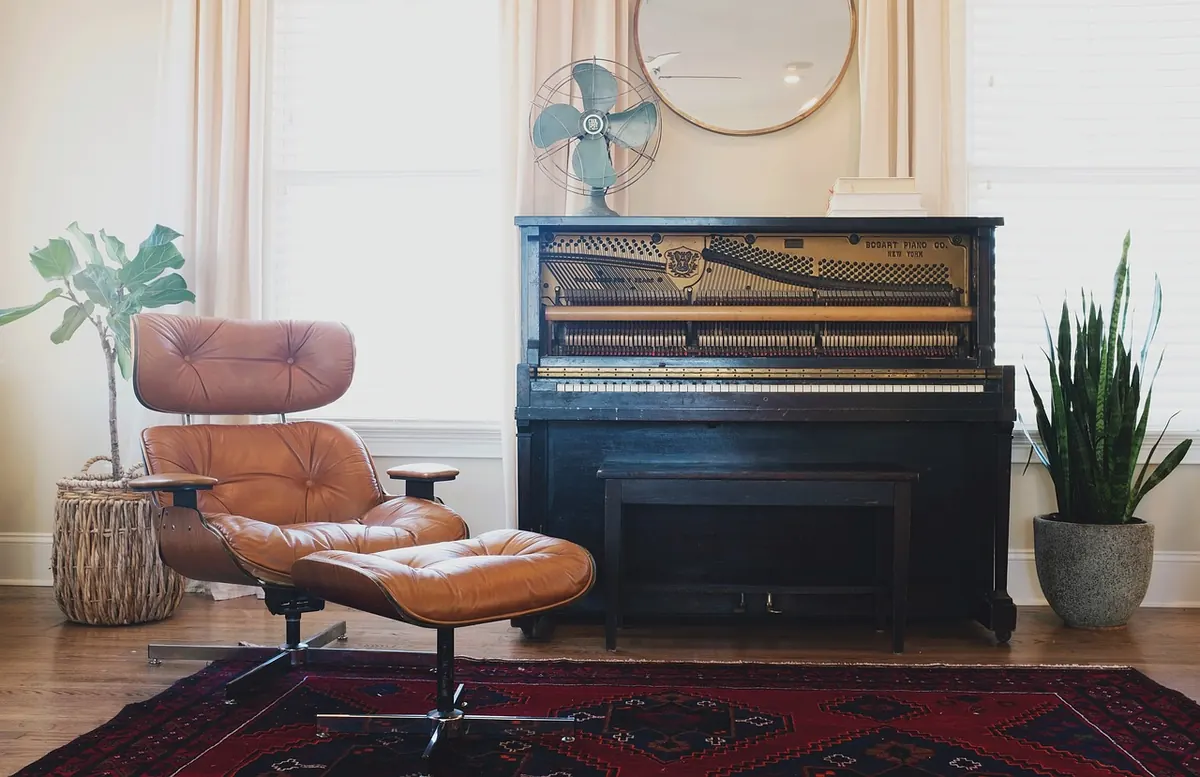
A living room can hold beautiful furniture and still fall flat. Usually the blame lies with the light. One bright ceiling fitting doing all the work creates a showroom glare: everything lit, nothing inviting. Luxury, in lighting terms, is really about layers — several small, warm pools of light, each doing one job properly, arranged so you rarely notice the source itself. Get that right and a modest room starts to feel considered and calm.
The Three Layers, and Why One Is Never Enough
Think of ambient light as the base note: soft, even illumination that lets you cross the room safely. Task light is directional and purposeful — a lamp angled over a book, a light beside the chair where you write. Accent light is the flourish: the low glow that picks out a painting, a shelf of books, a plant, a stretch of panelling.
Most British living rooms have only the first, delivered by a single pendant on a rose, and it shows. As a working target, aim for five separate sources in a medium-sized room and eight in a generous one. They should not all be the same brightness, or the same height, and ideally they should not all come on at once.
Ambient Light: A Soft Base, Not a Spotlight
If your only ceiling light is a pendant, don't scrap it. Put it on a dimmer and swap the shade for a fabric drum or a wide paper one that spreads light sideways rather than aiming it at the coffee table. In the evening it can sit at a third of its output and do nothing more than take the darkness off the ceiling.
Recessed downlights need more care. A grid of them switched from one plate flattens a room instantly. If they are already fitted, have them wired in rows so you can run the ones near the walls and leave the ones over the sofa off. Keep downlights away from seating, where they drill into scalps and reflect off glasses.
Two quiet tricks are worth the effort. A floor uplighter tucked behind an armchair throws light onto the ceiling, which bounces back down and makes the room feel taller. A dimmed wall light on the chimney breast does the opposite, washing texture across the brick or plaster without creating a hot spot. Both cost almost nothing in visual clutter.
Task Light: Put It Where Your Hands Are
Task lighting is where comfort lives. If you read in a particular chair, that chair deserves its own lamp, and it should be a floor lamp with an adjustable head rather than something decorative. Position it so the arm leans over your shoulder and the shade sits below your seated eye level. You will not see the bulb, and the page will be brighter than everything around it. That contrast is the point.
Table lamps follow a simple rule of thumb: the bottom of the shade should land roughly at your shoulder when you are sitting down. In practice that means a lamp around 55 to 75cm tall on a standard side table. Any taller and you will be looking at the bulb; any shorter and the light pools too low to read by.
- Reading chair: one floor lamp with an adjustable head, angled over the shoulder, not in front of the face.
- Writing desk or work corner: a focused lamp with a white inner shade, which reflects light back down onto the paper.
- Television wall: low, warm light placed beside or behind you, never opposite the screen. A bright lamp facing the television turns every dark scene into a mirror.
- Sofa ends: if the sofa backs onto a wall, consider slim wall lights above each end rather than squeezing in side tables.
Accent Light: Where the Expensive Feeling Comes From
The difference between a pleasant room and one that reads as expensive is almost always the third layer. Accent light tells the eye where to look, and it does so with restraint.
Useful places to start: a picture light or a narrow beam aimed at a favourite canvas, a warm LED strip tucked into an alcove or along the underside of a shelf, a small lamp on a sideboard that lights nothing in particular, a battery puck light inside a bookcase, an uplight behind a large plant so its leaves cast shadows up the wall. A mirror opposite a lamp doubles the effect for free.
Variety matters more than symmetry. A matched pair of identical lamps flanking the sofa tends to read as a hotel lobby rather than a home. Vary the heights, the shade shapes and the bases — a ceramic, a brass, a glass — while keeping the colour of the light itself consistent. Nothing undoes good layering faster than a warm lamp next to a cold one.
Bulbs and Dimmers: The Unseen Half of the Job
Colour temperature
For living rooms, warm is correct. Look for 2700K as standard, and 2200K to 2400K for accent pieces and anything you want to feel candle-like. Cool white bulbs belong in a utility room or a garage, not beside a sofa. If a bulb's packaging makes it hard to tell, buy one, fit it, and judge it in the evening with the curtains closed.
Dimming
Dimming is what separates layered lighting from simply having lots of lights. Every layer should ideally be adjustable, and lamps can share the same circuit through a switchable plug adaptor or a smart plug, so one switch dims the whole cluster. Dimmers and bulbs must be compatible; if a fitting buzzes or flickers, that is a mismatch rather than a fault. Ask an electrician if you are unsure, particularly with older wiring.
Shades and glare
Opaque shades push light up and down and can put a bright patch on the ceiling. Fabric shades soften and spread it. Either is fine — just sit where you normally sit and check whether you can see the bulb itself. If you can, move the lamp or change the shade.
Mistakes That Flatten a Room
- Relying on one ceiling fitting for everything.
- Mixing colour temperatures across a single room.
- Lamps placed so high that you stare straight into them.
- Identical lamps in symmetrical pairs, which kill any sense of layering.
- Downlights aimed hard at walls, which graze the plaster and show every imperfection.
- Bright light on the television wall.
- Everything on at once, at full strength, at eight o'clock.
Room by Room
The formal sitting room
Lean on ambient restraint and accent. A dimmed pendant or two wall lights, a lamp at each end of the sofa, one picture light, and a low glow on a sideboard is plenty. Keep the overall level low; this is a room for talking, not for reading the small print.
The everyday family living room
Task lighting earns its keep here. A floor lamp for the reading chair, a robust table lamp for homework or laptops, and a dimmed ceiling light for tidying up. Choose shades that can take a knock and bulbs that are easy to replace in a hurry.
An open-plan space
Light the zones, not the whole floor. A pendant over the dining table, a lamp cluster near the sofa, and cabinetry lighting in the kitchen area will do more for the room than one vast wash of light. Dim each zone separately, so an evening with guests by the sofa does not illuminate a kitchen that has already been cleared.
Small flats and rented homes
Work with what you have. Plug-in dimmers on lamps, freestanding uplighters, battery lights in alcoves and a well-placed mirror can transform a room without touching the wiring. Always have any electrical changes carried out by a qualified electrician.
Tonight's Two-Step Fix
Turn off the overhead light and put on every lamp you own. Sit down where you usually sit and note which ones glare, which ones leave a dark corner, and which one you would happily lose. Then move one lamp to fill the gap and plug the cluster into a single switchable adaptor so you can dim them together. Live with it for a week. Most people find they stop using the ceiling light altogether — and the room, without a single new purchase, starts to feel considerably more generous.
Photo: Pexels / Pixabay